
For decades, the standard advice was simple: change your oil every 3,000 miles. But synthetic oils have rewritten the rulebook. If you’ve switched to synthetic—or are considering it—you’ve likely heard conflicting recommendations ranging from 5,000 to 15,000 miles between changes. So, what’s the real answer?
The Short Answer: It Depends on Your Driving
No single mileage number works for everyone. While many synthetic oils are formulated to last 7,500 to 10,000 miles under normal conditions, several factors can push that interval up or down. The best source of truth is your vehicle’s owner’s manual—manufacturers test extensively to determine safe limits for your specific engine.
Normal vs. Severe Driving Conditions
Most drivers fall into the “severe” category without realizing it. Severe conditions include:
- Frequent short trips (under 5–10 miles)
- Stop-and-go city traffic
- Extreme hot or cold climates
- Towing or carrying heavy loads
- Driving on dusty or unpaved roads
- Extensive idling (delivery drivers, police, taxi)
If any of these describe your routine, you should follow the severe-duty schedule—typically every 5,000 miles with synthetic, not 10,000.
Why Synthetic Oil Lasts Longer Than Conventional
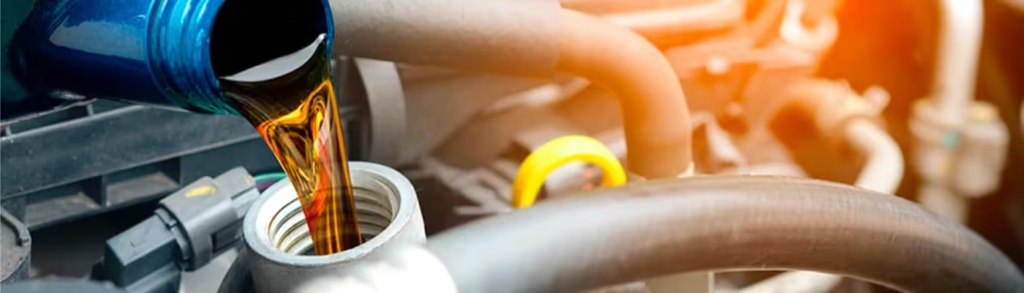
Synthetic oil is engineered from chemically modified petroleum components or fully synthesized base stocks. Unlike conventional oil, it resists thermal breakdown, flows better at low temperatures, and maintains viscosity longer. Its uniform molecular structure means fewer impurities that can sludge or evaporate.
That’s why synthetics can often go 7,500–15,000 miles between changes, whereas conventional oil starts degrading around 3,000–5,000 miles.
The Role of Your Vehicle’s Oil Life Monitor
Most cars built after 2010 have an oil life monitoring system (OLM). These systems track engine revolutions, temperature, driving time, and even cold starts to calculate remaining oil life.
You can trust these monitors—within reason. Studies by automakers like Ford and GM show their OLMs reliably indicate when oil has degraded to about 50% of its remaining useful life. However, if you drive in extreme severe conditions, err on the side of changing earlier than the monitor suggests.
Mileage Guidelines by Driving Type
| Driving Condition | Synthetic Oil Change Interval |
|---|---|
| Normal (highway, moderate climate) | 7,500 – 10,000 miles |
| Severe (city, short trips, towing) | 5,000 – 7,500 miles |
| Extreme (track days, heavy towing, desert) | 3,000 – 5,000 miles |
Time Matters Too, Even If You Don’t Drive Much
Oil degrades over time due to oxidation and moisture accumulation. Even if you haven’t reached the mileage limit, most experts recommend changing synthetic oil at least once a year. After 12 months, additives deplete and condensation can form acids that corrode engine components.
Signs You Need a Change Sooner
Ignore rigid intervals if you notice:
- Dark, gritty oil on the dipstick
- Increased engine noise or rough idling
- Oil smell inside the cabin
- Check engine or oil pressure light
- Excessive exhaust smoke
The Risks of Extending Intervals Too Long
Pushing synthetic oil beyond 15,000 miles without oil analysis is risky. Overused oil loses its ability to suspend contaminants, leading to sludge buildup, clogged oil passages, and accelerated wear on bearings and camshafts. A $60 oil change is cheap insurance compared to a $5,000 engine repair.
When to Consider Oil Analysis
For high-performance engines, fleet vehicles, or if you want to maximize intervals safely, send a sample to a lab like Blackstone Laboratories. They’ll measure viscosity, metallic wear particles, and additive remaining. With analysis, some synthetics can safely reach 15,000–20,000 miles.
Final Verdict: A Practical Rule of Thumb
- Most drivers using full synthetic: change every 7,500 miles or 12 months, whichever comes first.
- Frequent severe driving: change every 5,000 miles.
- Always check your owner’s manual first—some European cars require 10,000+ intervals with specific synthetic grades.
- Use a high-quality synthetic (Mobil 1, Amsoil, Castrol Edge, Pennzoil Platinum) and a premium filter.
When in doubt, change it early. Modern synthetic oil is remarkable, but no oil lasts forever. Pay attention to how you drive, and your engine will reward you with years of reliable service.